
New Yorkers do not hand out forgiveness easily. James Dolan knows this better than most.
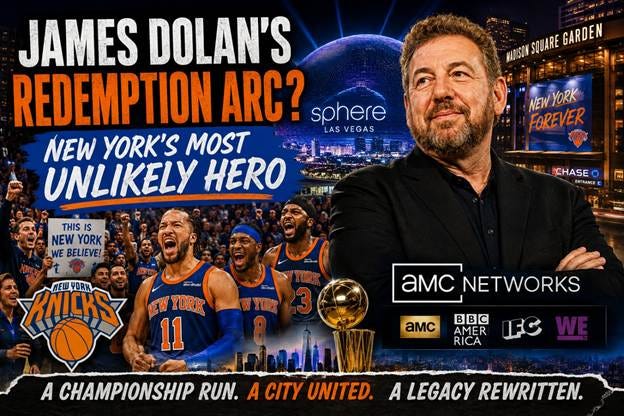
For two decades, Jim Dolan has occupied a peculiar place in New York civic mythology: not merely a sports owner, but a symbol. For many Knicks fans, he became the embodiment of inherited privilege, managerial stubbornness, and unrealized possibility. For Yankees fans of a certain generation, there remains the enduring resentment that Dolan’s opposition helped derail the proposed West Side stadium project that could have relocated Yankee Stadium to Manhattan’s far west side, a political fight that ultimately collapsed amid broad opposition and competing interests. In the mythology of sports grievance, nuance rarely survives.
And yet here we are.

Knicks fans, some of whom spent much of adult life cursing his name, are suddenly daring to imagine James Dolan as owner of the team that brought basketball glory back to New York.
That is not a small cultural shift.
Because if this Knicks run ends with a championship parade down the Canyon of Heroes, Dolan’s public biography changes overnight.
Not completely. New Yorkers have long memories. But materially.
The facts are harder to dismiss than the reputation. Dolan oversees an empire that includes Madison Square Garden Sports, Madison Square Garden Entertainment, and Sphere Entertainment, whose Las Vegas Sphere has evolved from punchline to proof point, with Sphere Entertainment recently reporting sharply improved operating performance as the venue’s economics strengthened. He remains Executive Chairman and CEO across a sprawling collection of interlocking assets that still includes deep ties to AMC Networks through the Dolan family control structure.
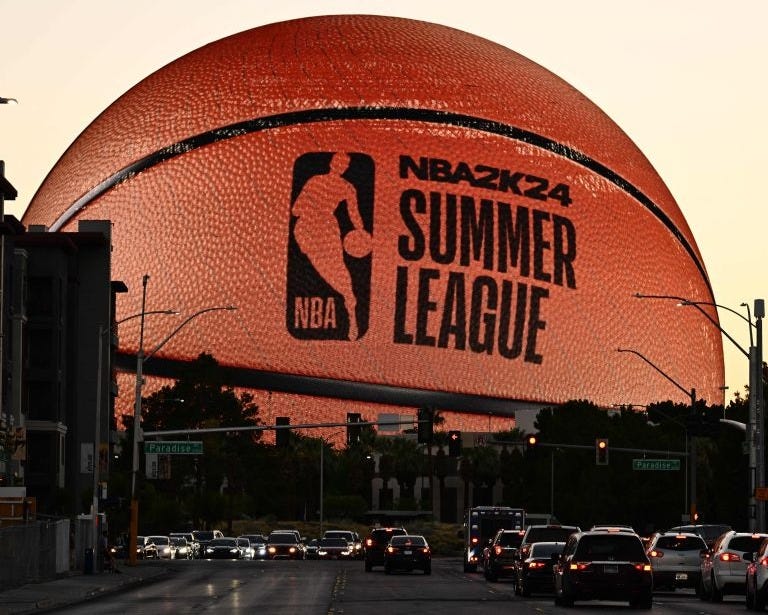
The Spere as a new cultural icon.
Which raises the larger question.
What if James Dolan was not incompetent, but simply early in some arenas, stubborn in others, and catastrophically poor at public relations?
That does not excuse the Knicks’ long wilderness. Or the Rangers’ maddening habit of inspiring hope before delivering emotional blunt-force trauma.
Or Dolan’s famously combative posture with critics and fans, which helped harden his image as sports ownership’s designated villain.
But history is often kinder to operators than contemporaries are.
The Sphere matters here because Sphere is not merely a venue. It is a strategic bet on experiential scarcity in an age of infinite digital abundance. That is not legacy thinking. That is future architecture.
Media leaders should recognize the pattern.
Dolan came out of Long Island’s Cablevision, founded by Jim’s father Chuck Dolan. Cable taught a generation of executives that control of distribution meant control of economics. The digital era dismantled that assumption. Sphere is a counter-move: if content becomes infinitely replicable, then experience becomes premium.
That is a sophisticated thesis. One that worked.
The Knicks, meanwhile, may be his most important reputational asset of all. Not because sports teams are financially transformative relative to the broader portfolio. Because civic emotion is more powerful than investor decks.
Win New York, and narrative changes. Lose New York, and everything else gets discounted.
Which brings us to AMC Networks. This is where the next chapter gets interesting.
AMC was once one of the smartest brands in media. Mad Men. Breaking Bad. A company that punched far above its scale because it understood cultural curation before algorithms industrialized attention.
Now it feels strategically stranded.
Too small to dominate.
Too legacy to scale independently.
Too valuable to be irrelevant.
Yet Netflix as a strategic acquirer is compelling. Netflix would understand the value of curated premium IP and brand identity far better than Warner Bros. Discovery, whose integration challenges with Skydance/Paramount already suggest indigestion, not appetite.
A Netflix-AMC scenario would not be about library aggregation alone. It would be about brand coherence. Ted Sarandos has long understood that premium storytelling is both economics and cultural signaling. AMC, under the right ownership, could regain strategic meaning.

That said, other suitors may make more economic sense depending on valuation and regulatory appetite. But strategically? Netflix feels smarter.
So where does that leave James Dolan? Possibly in the middle of the most improbable narrative reversal in New York business.
The villain becomes visionary. The owner fans loved to hate becomes the architect of a championship. The cable heir becomes the experiential futurist. There is finally something behind the curtain and Dolan’s prayers come true.
That may be too neat but New York loves reinvention almost as much as it loves grievance. And if the Knicks finish this run? The loudest sound in Madison Square Garden may not be celebration.
It may be millions of New Yorkers quietly revising their opinion of James Dolan, and I admit I will be among them. How about you?

