
After decades navigating media, technology, streaming, and digital transformation, Marc DeBevoise remains convinced that leadership’s greatest competitive advantage is still unmistakably human.
There are executives who speak fluently about transformation because they have studied it. Then there are those who have lived through enough transformation to recognize the difference between structural change and temporary noise.
Marc DeBevoise belongs firmly in the latter category.
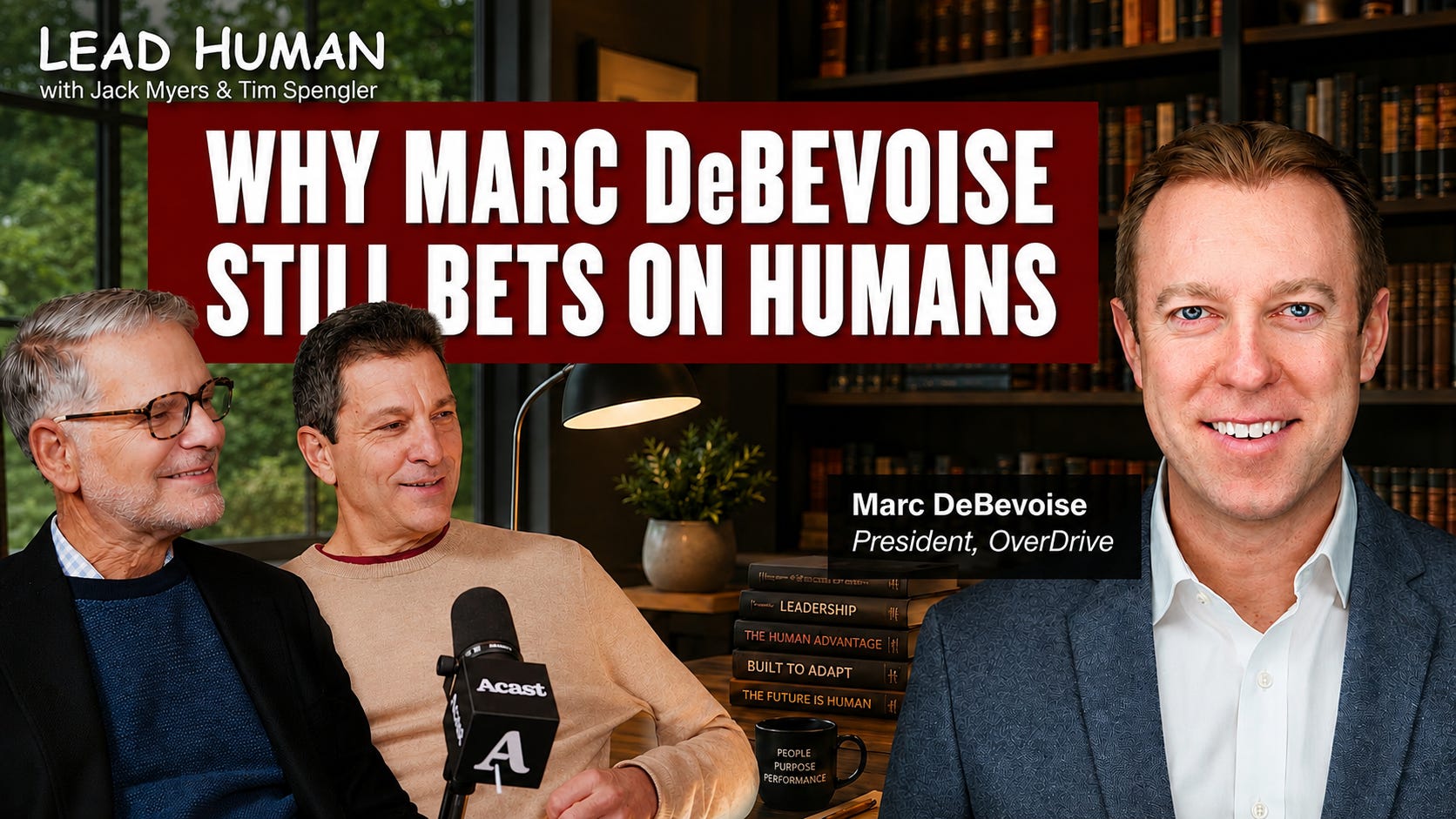
Our recent Lead Human with Jack Myers and Tim Spengler conversation with Marc offered something increasingly rare in discussions about leadership and technology: perspective without hype. His career spans the early internet boom, the evolution of digital media, the birth of streaming as a mainstream business model, major operational turnarounds, and now a mission-driven leadership role as President of OverDrive, whose platforms help deliver digital reading, literacy, and educational access in more than 115 countries.
You can listen to the full conversation with Marc on Lead Human with Jack Myers and Tim Spengler at your favorite podcast platform and view at YouTube. Link to the full archive and all podcast platforms at www.lead-human.com. It is worth engaging with in full because what Marc reveals is not widely discussed, even among those familiar with his work.
That breadth matters because it gives Marc a practical vantage point. He has seen technological enthusiasm before. He has participated in real disruption. He has helped build businesses through uncertainty. What emerged in conversation was not simply a seasoned executive’s résumé, but a thoughtful leadership philosophy grounded in accountability, trust, disciplined risk-taking, and a belief that technology’s long-term value still depends on human judgment.
Marc’s description of his leadership style was immediately revealing.
“I like to refer to my style as empathetic accountability.”
That phrase could easily sound like consultant language in less capable hands. Marc made it deeply personal. “Do you have a Jewish or a Catholic grandmother?” he asked. “It’s that belief that you don’t want to disappoint them and you’re accountable to them if you don’t do your best.”
It was a line that instantly humanized his philosophy. Behind the humor was a serious management principle: high expectations paired with genuine support. Too often, leadership conversations separate empathy from accountability, as though one weakens the other. Marc’s experience suggests precisely the opposite. Teams perform best when expectations are clear, goals are transparent, and leaders behave like people rather than abstractions.
That same clarity shapes how he operates day to day.
“I prefer goals that are three bullets of yes and three bullets of what not to do.”
This is classic operational discipline. Simplicity, not simplification. Leaders who thrive under pressure tend to reduce ambiguity rather than create more of it. Marc repeatedly returned to the importance of planning, alignment, and establishing clear markers for execution, lessons rooted partly in his early career at NBC during the GE era, where structured planning systems forced long-term thinking even inside quarterly business realities.
That perspective became especially relevant when our conversation turned to artificial intelligence. Because Marc has lived through one technology wave that fundamentally reshaped business, his views on AI deserve particular attention.
“What I take away is that explosion is where I feel like we are now in AI.”
That comparison to the early internet era is useful, but Marc avoids the simplistic conclusion that AI’s path will precisely mirror digital’s. His point is more nuanced. There is real transformation underway, but transformation unfolds across longer arcs than hype cycles suggest.
“It’s quick change that you see is impacting us and it’s going to be a long arc.”
That observation cuts through much of today’s AI commentary. Venture-backed enthusiasm often frames change in compressed timelines because urgency serves fundraising narratives. Operators who have managed actual transformation know better. Business models, institutions, cultures, and human behaviors rarely reinvent themselves at the pace of investor decks.
Marc’s experience launching CBS All Access, one of the early direct-to-consumer streaming ventures, reinforces that view. Streaming’s strategic inevitability became visible long before its business models stabilized. AI may follow a similar pattern, with immediate disruption layered atop slower institutional adaptation.
His observations on public-company leadership were equally pointed. “Every business is not a quarterly business.”
That simple sentence carries significant weight. One of modern executive leadership’s persistent tensions is balancing investor expectations with operational reality. Businesses operate on different rhythms. Media, travel, software, education, and consumer services do not all move according to identical calendars. Marc’s accountability framework applies upward as much as downward, emphasizing transparency between management teams and leadership rather than unrealistic performance theater.
One of the most revealing moments came during our discussion of risk. Marc keeps a seventeenth-century map of Manhattan on his wall, reflecting his family’s roots as early Dutch settlers. It serves as a reminder not of heritage alone, but of perspective.
“These are people that got on a boat for three months and threw their life into this one venture.”
That framing says much about how Marc thinks. Leadership often involves imperfect timing, incomplete information, and uncomfortable decisions. He readily acknowledged that his own career includes wrong bets alongside successful ones. The point is not predictive perfection. It is thoughtful action.
That pragmatism helped define his successful turnaround at Brightcove, where he leaned into urgency, team belief, and operational execution to return the business to growth and profitability.
Yet perhaps the most compelling part of the conversation was Marc’s discussion of why he chose OverDrive. After decades in media and technology, he deliberately moved toward a mission-centered business. “We are here to promote reading and literacy and knowledge across the globe.”
That statement resonates differently today, when so much technology conversation focuses on automation, efficiency, and scale. Marc’s enthusiasm for OverDrive reflects a deeper alignment between leadership and purpose. His board work with The Door, supporting at-risk young people through education, healthcare, legal services, and wraparound support, reinforces that this commitment is not rhetorical.
Late in the conversation, Marc offered advice that may be the most important takeaway for leaders considering their next chapter.
“Find something that you can be engaged in.” Not merely interested in. Not superficially excited by. Truly engaged.
Because careers, like leadership, inevitably include hard seasons, difficult decisions, and moments where novelty fades. Technology can improve leverage. AI can accelerate workflows. Systems can optimize execution.
None of them replace conviction, judgment, or human commitment.
Marc DeBevoise has spent a career helping organizations navigate technological change. What makes him particularly worth listening to is that he still understands where the real leverage resides.
In people.
If you have not yet listened to or watched this Lead Human conversation, I strongly encourage it. Marc brings the kind of thoughtful realism our leadership conversations need far more of today.
You can listen to the full conversation with Marc on Lead Human with Jack Myers and Tim Spengler at your favorite podcast platform and view at YouTube. Link to the full archive and all podcast platforms at www.lead-human.com. It is worth engaging with in full because what Marc reveals is not widely discussed, even among those familiar with his work.
