The most powerful companies in the world are not selling products. They are selling predictions about you. And the deeper truth is more unsettling than most leaders are willing to admit.
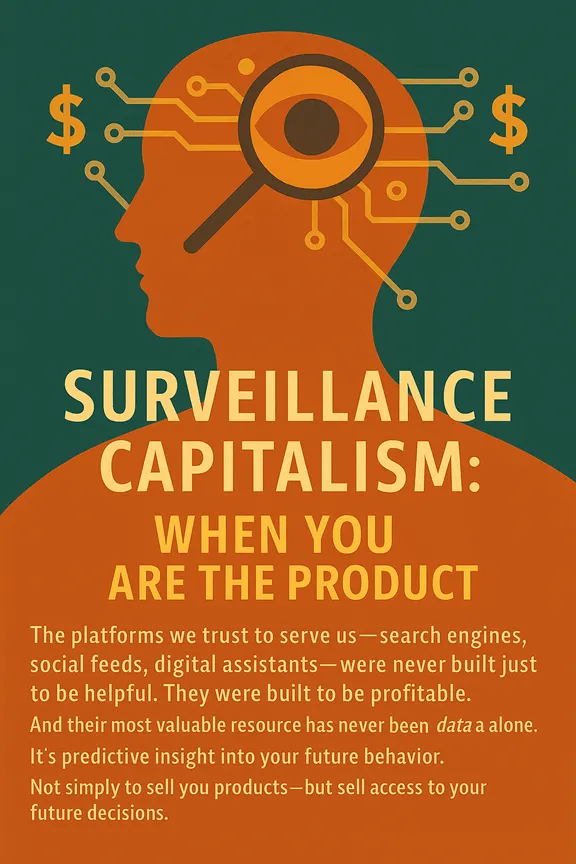 The image is not metaphor. It is a simplified diagram of the dominant economic system of the digital age.
The term surveillance capitalism, introduced and rigorously defined by Shoshana Zuboff, describes a model in which human experience is translated into behavioral data, processed at scale, and converted into predictive products. These products are not ads in the traditional sense. They are probabilistic forecasts of what you will do next.
This is not theory. It is the revenue engine behind Alphabet Inc., Meta Platforms, and increasingly, AI-driven platforms including OpenAI and its emerging ecosystem.
Consider the economics. Alphabet generated over $300 billion in revenue in recent fiscal reporting, the majority derived from advertising systems fueled by user intent signals, location data, and behavioral histories. Meta’s business model similarly depends on continuous engagement tracking across billions of users. These companies do not need perfect accuracy. They need directional certainty at scale. A one percent improvement in prediction translates into billions in incremental revenue.
What has changed, and why the image matters now, is the expansion from observation to influence.
Platforms are no longer just predicting behavior. They are shaping it. Recommendation engines, feed algorithms, and conversational AI systems create environments that subtly steer choices, compress discovery, and reinforce patterns. The product is no longer access to audiences. The product is access to future decisions.
That is the threat. Not loss of privacy alone, but loss of agency at scale.
The strategic implication for leaders is clear. Data asymmetry has become power asymmetry. The entities that control predictive systems increasingly control economic outcomes, cultural narratives, and consumer behavior.
This is where a different model of intelligence becomes necessary. This is no longer the territory of dystopian fiction. It’s the everyday UX of your life. And the more effective these systems become, the harder it is to see them for what they are. Because the more personalized an experience is, the less visible it becomes to anyone else.
What my new book Your Third Brain: Powering a Future of Unimagined Possibilities argues, and what this moment demands, is not resistance to technology but conscious integration. Human judgment, contextual awareness, and ethical reasoning must operate in partnership with machine intelligence, not in submission to it. The defense is not withdrawal. It is amplification of distinctly human capabilities that algorithms cannot replicate at scale. (Pre-order your paperback or eBook of Your Third Brain here and at all booksellers.)
Discernment. Intentionality. Awareness of influence. The platforms are optimizing for your next action. Your responsibility is to decide whether it will be yours.