
What OpenAI’s advertising move means for every organization in the business of selling audience access — and why the window for responding is shorter than it looks
Fifteen weeks into its advertising pilot, OpenAI has done what every dominant platform eventually does: it turned attention into inventory.
The self-serve Ads Manager launched in May 2026 lets advertisers create and optimize campaigns directly inside ChatGPT. The integrations include Dentsu, Omnicom, Publicis, WPP, Adobe, Criteo, and StackAdapt. The revenue targets are $2 billion by year-end and $102 billion annually by 2030. The platform has 810 million monthly active users. Your agency partners are already inside it.
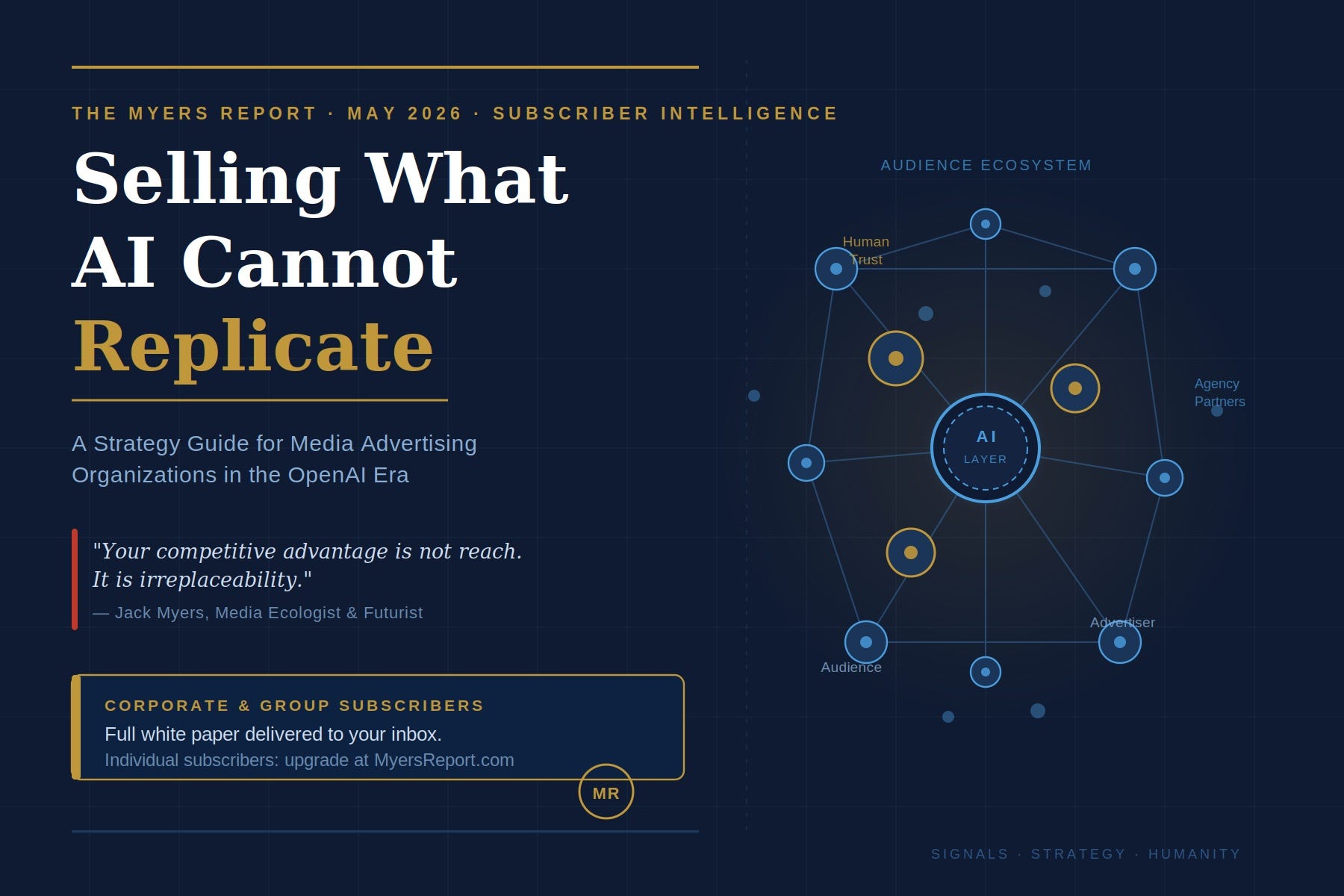
This week I am sending corporate and group subscribers a full Myers Report white paper on this topic: How to Compete as AI Enters the Ad Market. It runs 2,500 words and includes six specific action items for organizations responsible for advertising revenue and agency relationships, executable within 90 days. If your organization subscribes at the corporate level, it is in your inbox now.
I want to be precise about what this is and what it is not.
It is not a new channel competing for advertising dollars, though it is that too. It is not a search replacement, though it is accelerating that shift. What it is — what makes this moment different from every previous disruption I have covered across five decades in media economics — is the monetization of the conversational layer itself.
Until now, the intermediary between a consumer and a brand was media. Content. A context that an audience chose to inhabit and that advertisers paid to enter. The audience was the relationship. The media company was the trusted party.
What is being built inside ChatGPT, and shortly inside Gemini, is something architecturally different. It is a system that mediates every question, every decision, every purchase consideration — and that is now selling access to that mediation. The consumer does not see a banner. There is no “Sponsored” label in the margin. There is a response. And the entity crafting that response has commercial interests it is under no obligation to make explicit.
This is a media ecology problem, not just a market share problem. And it is arriving precisely as audiences are delegating more of their judgment to AI systems, not less.
Deloitte’s 2026 Global Human Capital Trends survey found that 60 percent of executives now regularly use AI to support their decisions. Consumer behavior is tracking the same direction. The audiences your advertisers are trying to reach are increasingly consulting AI before they decide what to watch, what to buy, and what to believe. When that consultation happens inside a monetized environment, the economics of attention change in ways that existing measurement systems are not designed to capture.
There are three things I believe about this moment that most of the current analysis is missing.
First, the organizations most exposed are not the ones you would expect. The obvious story is that Google faces an existential threat from conversational AI. That is true and has been widely covered. The less-covered story is that the television and streaming networks — the organizations that have spent decades building trusted audience relationships through content, talent, and cultural resonance — are now competing with a platform that can approximate that relationship at scale without having earned it. Your audience trust is an asset. It is also, if you are not careful, a subsidy for the conversational AI that your audience turns to after they finish watching.
Second, the holding company integrations matter more than the platform itself. Dentsu, Omnicom, Publicis, and WPP are already inside the ChatGPT Ads Manager ecosystem. Those are the same agency partners managing the budgets your sales organizations are negotiating against right now. The question of where AI advertising dollars are coming from — whether they are incremental or cannibalized from linear and streaming — is not being asked directly in most agency conversations. It should be. (Note: The Trade Desk is reported to have entered into a partnership in which OpenAI will invest in the company.)
Third, the cultural signal is moving faster than the business signal. The Academy of Motion Picture Arts and Sciences clarified in May that AI-generated performances and AI-written screenplays are not eligible for Oscar recognition. That ruling is a lagging indicator, not a leading one. When the Academy moves, the cultural conversation has already shifted. A meaningful segment of the audience is drawing lines around human authorship and demanding that institutions honor them. For the networks and media companies whose brand equity rests on human storytelling, creative authorship, and community trust, that is not a constraint. It is a competitive advantage — if it is claimed.
If you receive this newsletter as an individual subscriber and want access to the full report and recommendations, corporate subscription information is available at MyersReport.com and group subscriptions can be ordered at the link below. The economics of this conversation are going to move faster than the next planning cycle. I wrote the report accordingly.
