
Annual ad growth of 6% suggests stability. The underlying reality is that AI is absorbing the next $250 billion growth and forcing a massive reallocation of value across the advertising ecosystem.
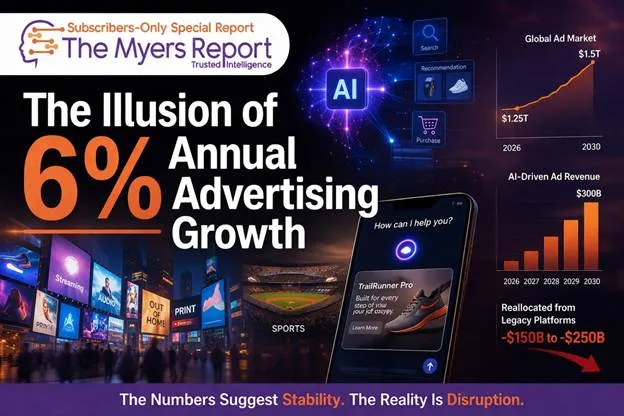
The global advertising market appears, at first glance, to be behaving exactly as expected. From approximately $1.25 trillion in 2026, forecasts point to a market of roughly $1.5 trillion by 2030. A steady, predictable expansion. Representing $250 billion in incremental annual ad spend by 2030.
For a mature industry, that is a healthy outcome. It is also deeply misleading. Because embedded inside that $250 billion expansion is a force that is not additive, but extractive. AI-native platforms are not simply participating in the next phase of growth. They are absorbing it and exceeding it.
in the Subscriber-only Report to be published later today, I quantify the likely losers and winners, and outline the strategic moves required to protect growth and preserve pricing power in an AI-mediated market. Scroll down for my extensive market analysis on projected AI ad revenues.
Layer in the broader AI ecosystem:
- Google’s Gemini integration across search and media
- Microsoft’s Copilot embedding across enterprise and consumer workflows
- xAI’s Grok within real-time social environments
- Anthropic and emerging trust-first models that may introduce premium monetization layers
Even conservative estimates suggest that AI-driven advertising will reach $200 billion to $300 billion by 2030. Pause on that. The total market grows by $250 billion. AI alone captures as much or more than that growth.
That is not expansion. It is redistribution at scale. The implications extend far beyond platform competition. This is a redefinition of how advertising works. For decades, the industry has been structured around access to audiences. Media companies aggregated attention, brands purchased exposure, and value was determined by reach and frequency. The past two decades witnessed a shift to efficiency-based programmatic models, commerce media, and principal media.
AI collapses both models. It replaces inferred behavior with declared intent. It replaces fragmented journeys with continuous decision environments. It shifts value from content adjacency and performance measures to explicit decision proximity and full funnel purchasing process.
In practical terms, the center of gravity moves:
- From media channels
- To intelligence interfaces
The economic consequence is immediate. If AI captures $200 billion to $300 billion in revenue within a market that only grows $250 billion, then a significant portion of that value must be reallocated from existing systems.
The first-order impact is already visible.
Search, social, and commerce media face direct pressure as AI intermediates discovery and decision-making. But the second-order effects are broader and more consequential.
Television, predominantly CTV and streaming, continues to grow slowly, but its role shifts from primary planning anchor to supplemental reach layer. Audio and podcasting retain their intimacy but lose discovery leverage. Digital publishing faces further erosion as AI absorbs referral traffic and reduces the need for destination-based consumption.
Even programmatic platforms such as The Trade Desk and Yahoo confront a structural question: whether they remain decision engines or become execution layers within AI-driven systems.
There are exceptions. Live sports and premium content retain scarcity and cultural relevance. Organizations such as the National Football League, MLS, and the NBA continue to command attention that cannot be replicated by algorithms.
But even here, the shift is subtle and significant. They do not lose demand. They lose unquestioned pricing power. The cumulative effect is not uniform decline. It is uneven pressure:
- Some sectors lose revenue
- Others lose growth
- Many lose control
The market, in aggregate, continues to grow. But the distribution of value changes fundamentally. What makes this transition particularly difficult to navigate is that it does not present as crisis. There is no collapse in total spending. No sudden contraction.
Instead, there is a gradual but relentless repricing of value. Margins compress. Growth slows. Dependency increases. And the locus of control moves upstream, toward those who mediate decisions rather than those who distribute content.
This is the shift most organizations are not yet modeling. They are still asking how AI will enhance their media strategies. The more relevant question is how AI will redefine the economics those strategies depend on.
Because once decision-making becomes centralized within AI systems, the rest of the ecosystem becomes, to varying degrees, downstream. The numbers make the case.
- ~$250 billion in total market growth
- $200 billion to $300 billion in AI-driven revenue
- An implied reallocation that reshapes the entire industry
The conclusion is unavoidable:
Advertising is no longer organized around media. It is being reorganized around intelligence.
The question that follows is not theoretical. It is operational.
Which media categories are best positioned to survive and grow in the next decade?
These are the questions I address in the Subscriber-only Report to be published later today, where I map the revenue exposure across search, commerce, social, CTV, programmatic, OOH, and publishing. I quantify the likely losers and winners, and outline the strategic moves required to protect growth and preserve pricing power in an AI-mediated market.
