
“I am what I play,” says Kristine Stone, who has spent 25 years behind the mic at SiriusXM. What she reveals in this conversation is not just how radio survived disruption, but why humanity still wins. Watch or listen at Lead Human with Jack Myers and Tim Spengler.
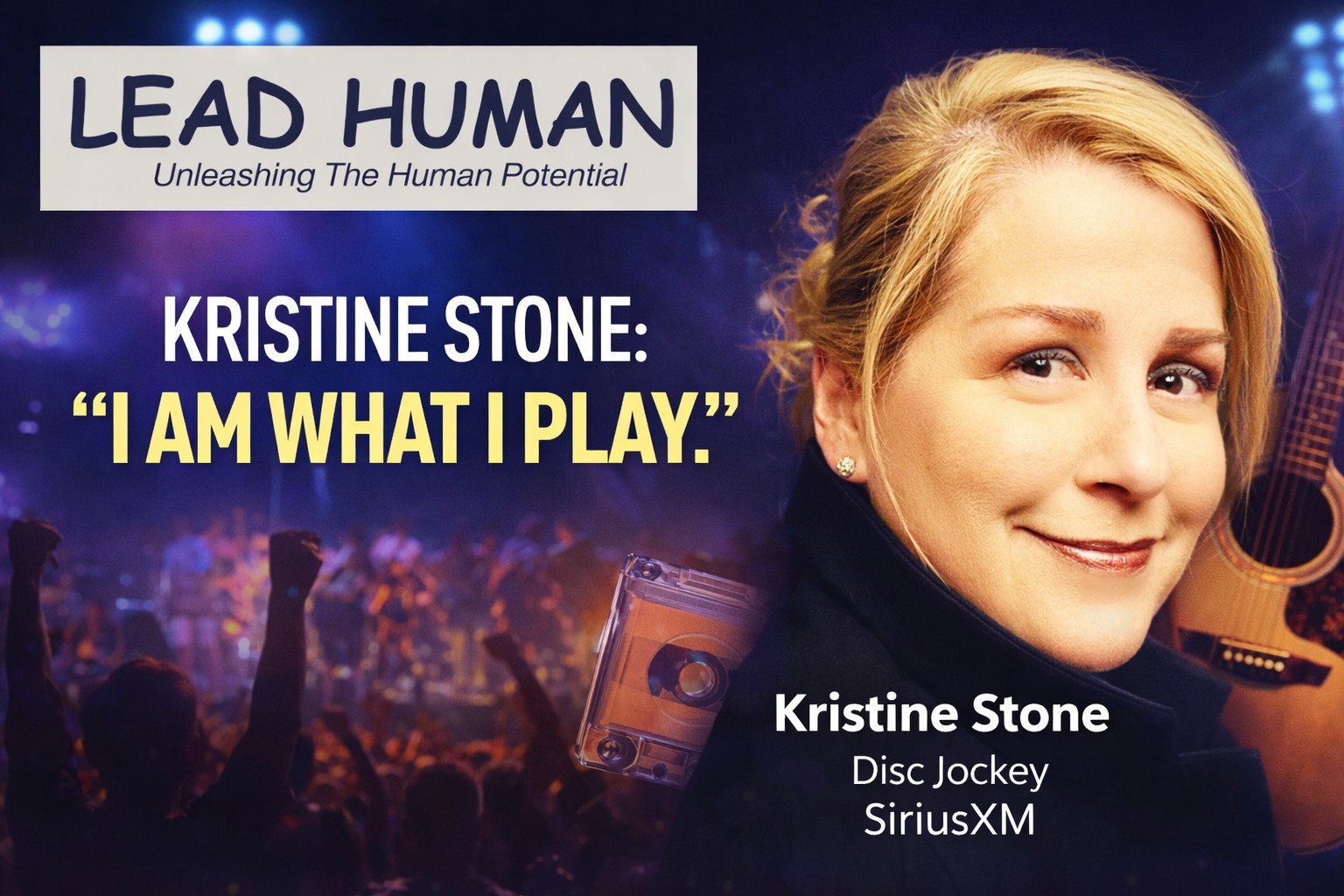
In a world chasing automation, Kristine Stone’s edge is something far simpler and far harder to replicate: presence, honesty, and the courage to sound like yourself. The most important line in our Lead Human conversation with Kristine Stone arrives early, almost casually: “I am what I play.”
It’s not branding. It’s not positioning. It is a philosophy of leadership, communication, and identity. Stone’s career, spanning nearly four decades and anchored by her work on The Spectrum and Classic Rewind, is less about music curation and more about emotional translation. Her job is not to fill airtime. It is to shape how people feel, one listener at a time.
That distinction matters more now than ever.
The One-to-One Economy
Stone’s most actionable insight for leaders is deceptively simple: speak to one person, not a crowd. She avoids “How’s everybody doing?” in favor of “How are you?” That shift from plural to singular reframes communication entirely. It turns broadcasting into connection. It transforms scale into intimacy.
In a boardroom, a Zoom call, or a keynote stage, the instinct is to generalize. Stone argues the opposite. Precision builds trust. Specificity signals respect. The takeaway is clear. In an age of mass reach, influence is built one relationship at a time.
Authenticity Is a Discipline
Stone rejects the idea that great communicators are “naturally” gifted. Her grandmother once told her she sounded monotonous. The voice that now reaches millions was built, not born. Her technique is both practical and revealing. She smiles when she speaks. Not as performance, but as intention.
It changes tone. It softens delivery. It creates warmth that travels through audio. Authenticity, in her framing, is not raw expression. It is calibrated honesty. It is the discipline of aligning how you feel with how you communicate, without exaggeration or artifice.
This is where many leaders fail. They confuse authenticity with spontaneity. Stone treats it as a craft.
The Pandemic Stress Test
When the world shut down in March 2020, radio did not pause. It adapted overnight. Stone describes a rapid pivot. Laptops, USB microphones, home studios. By Monday, the entire system was rebuilt. What followed was not decline. It was growth.
Listenership increased, particularly through digital channels. Specialty programming emerged to meet emotional needs during isolation. Radio became not just entertainment, but companionship.
The lesson is structural. When distribution changes, value does not disappear. It migrates to where human need is greatest. Stone’s dormer studio, roughly the size of a New York “phone booth,” became a node in a distributed network of connection. Technology enabled it. Humanity sustained it.
What AI Can’t Do
The conversation turns, inevitably, to AI. Stone is clear-eyed. Automation is coming. Some platforms are already experimenting with synthetic voices. But she identifies the boundary line. “What we do has to be something AI cannot reproduce.”
That “something” is not information. It is reaction. A spontaneous opinion about the Rock and Roll Hall of Fame. A moment of irritation expressed in real language. A story that wanders before it lands.
These are not inefficiencies. They are differentiators. AI can replicate structure. It can mimic tone. It can optimize playlists. It cannot care. And listeners know the difference.
Story as Memory
Stone is, by her own admission, a “sucker for history.” Every song carries a story. Every artist carries context. Her role blends entertainer, storyteller, and cultural historian.
The anecdote about nearly missing Robert Plant outside a Manhattan hotel captures this perfectly. A moment of hesitation in youth becomes a story of redemption decades later when she finally interviews him. It is funny, human, and unresolved in a way that scripted content rarely is.
These stories do more than entertain. They create memories. They give music a second life beyond sound. For leaders, the implication is direct. Data informs. Stories endure.
Leadership in Bands, Leadership in Business
When asked about leadership, Stone does not default to corporate frameworks. She points to bands.
Pink Floyd endured despite internal conflict. The Rolling Stones operate with clear authority under Mick Jagger. Eagles navigated succession through family continuity. The pattern is familiar. Alignment is not required. Output is. Great teams do not eliminate tension. They channel it toward creation.
The Real Takeaway
The most enduring insight from the conversation is not about radio. It is about identity.
Stone tried Top 40 early in her career. It did not fit. She was “meant to present rock and roll.” That clarity took time. It required rejecting formats that did not align with who she was. In a market increasingly defined by adaptability, this sounds counterintuitive. But it is the foundation of her longevity.
You do not scale by becoming everything. You scale by becoming unmistakably yourself.
The future of media, leadership, and communication will not be decided by who adopts AI fastest. It will be decided by who remains most human under pressure. Kristine Stone offers a blueprint. It is not technical. It is behavioral.
Speak to one person. Tell the truth. Build your voice. Protect what cannot be automated. Everything else is noise.
