AI capabilities are scaling faster than leadership structures, faster than ethical frameworks, and faster than the institutional systems designed to protect both consumers and brands.
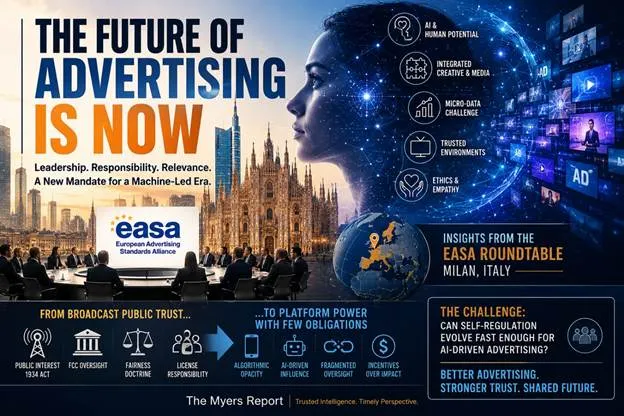
This week in Milan, I joined leaders from the European and international advertising self-regulation community for a roundtable hosted by EASA, the European Advertising Standards Alliance, in collaboration with ICAS, the international Council of Advertising Self-Regulation
Most American executives have likely never heard of EASA or ICAS. That, in itself, is revealing.
EASA serves as the umbrella alliance for Europe’s advertising self-regulatory ecosystem and ICAS for the expanded international community, bringing together national standards bodies, advertisers, agencies, media organizations, and digital stakeholders to create and enforce common principles for responsible advertising. Its members include organizations analogous to the UK’s Advertising Standards Authority, France’s ARPP, Italy’s IAP, and peer institutions across the globe. In practical terms, the two organizations represent the most mature attempt globally to balance industry autonomy with public accountability, with the noted exception of the United States.
The audience in Milan was not a typical marketing conference crowd. More than 80 participants included CEOs, policy leaders, standards executives, legal officers, and self-regulatory organization leaders from around the world. These are the people responsible for adjudicating complaints, setting advertising standards, and increasingly grappling with AI, platform governance, influencer transparency, and the ethics of digital persuasion.
Which made the central question especially relevant: Is self-regulation evolving fast enough for the systems it is now expected to govern?
That question was triggered by my keynote comments on The Future of Advertising Is Now.
The phrase sounds optimistic. It should also sound urgent. Because the future of advertising is not arriving someday. It is already here, while much of the industry continues behaving as though adaptation remains optional. More follows below on the issue of self-regulatory standards and U.S. engagement.
Artificial intelligence has already collapsed timelines between invention and consequence. Historically, media institutions had years, sometimes decades, to absorb technological change. Print evolved into radio. Radio into television. Television into cable. Cable into digital. Each transition gave institutions time to develop norms, incentives, and governance frameworks.
AI is not granting that luxury.
Capabilities are scaling faster than leadership structures, faster than ethical frameworks, and faster than the institutional systems designed to protect both consumers and brands.
That acceleration creates five immediate realities.
First, human potential in a machine-led era becomes the defining leadership question.
AI will make advertising faster, cheaper, and more predictive. But speed is not wisdom, and automation is not judgment. The winners in the next era will not be the organizations that deploy the most automation. They will be the ones that most effectively amplify uniquely human discernment, empathy, imagination, and trust.
Second, the long separation between creative and media increasingly looks like a relic of a previous operating model.
For two decades, advertising optimized around fragmentation. Creative agencies created. Media agencies distributed. Data firms measured. Platforms intermediated. AI collapses those distinctions. Context, audience intelligence, creative adaptation, and delivery increasingly operate as one integrated decision system. The future belongs to organizations capable of re-integration, not further specialization.
Third, the next competitive battleground is micro-data.
Not simply demographic targeting or behavioral signals, but granular contextual intelligence capable of anticipating emotional states, behavioral triggers, and decision vulnerability in real time.
This is where the ethical conversation becomes unavoidable because the question is no longer whether such capabilities exist. The question is whether the governance structures around them are remotely adequate.
Fourth, trusted environments gain value.
In a world saturated with synthetic media, misinformation, AI-generated clutter, and endless algorithmic noise, context becomes a premium asset. Legacy television, long dismissed as yesterday’s medium, may prove to be one of the most strategically undervalued trust environments in the marketplace.
Its future value is not nostalgia.
Its future value is trust.
And fifth, ethics and empathy move from cultural aspirations to business infrastructure.
Efficiency alone is a poor leadership philosophy. Systems optimized only for performance often erode trust, reward manipulation, and damage long-term brand equity. Ethics is no longer a public relations exercise. It is strategic operating discipline.
Which brings us back to self-regulation.
The regulatory ecosystem throughout Europe, the U.K., and other nations deserves more recognition in the United States.
Many Americans incorrectly assume advertising self-regulation barely exists. That is not true. Scroll down to continue reading. It’s free!
 The U.S. does have credible institutions, most notably the National Advertising Division under BBB National Programs. NAD is respected by advertisers, legal practitioners, and the Federal Trade Commission for resolving deceptive advertising claims and competitive disputes efficiently.
But there is an important distinction. America has industry self-regulation for review of competitive advertising. Europe has public-facing advertising accountability.
Most American consumers have never heard of NAD. It does not occupy the public role that organizations like the UK’s ASA do in their respective markets. It was built primarily to adjudicate advertising claims, not to govern algorithmic persuasion, platform-scale opacity, influencer ecosystems, or machine-speed synthetic media.
This is not a criticism of NAD. It is a recognition that the architecture of self-regulation was largely designed for a different advertising system.
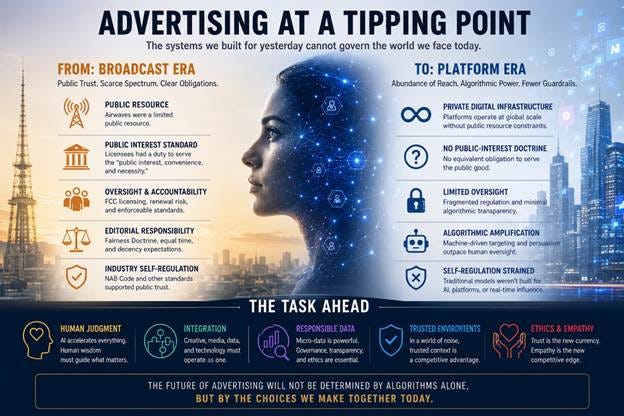
Historically, American broadcasting operated under a very different philosophy.
The Communications Act of 1934 established broadcasting as a public trust. License holders were expected to operate in the “public interest, convenience, and necessity.” Broadcast spectrum was considered a public resource, not merely a commercial asset. Institutions such as the FCC, the Fairness Doctrine, the Equal Time Rule, and the once-influential NAB Code reflected a broader assumption that media power carried civic obligations.
That model was imperfect. But it was a model.
Today’s dominant communications platforms influence billions with fewer public obligations than a local broadcaster once faced in a single American city.
No equivalent public-interest doctrine governs algorithmic amplification.
No meaningful transparency obligations govern recommendation systems.
No coherent accountability framework exists for many forms of machine-driven persuasion.
That gap should concern every brand leader.
Because fraud, misinformation, unsafe adjacency, and opaque supply chains are not abstract policy failures. They are market outcomes shaped by incentive structures.
Brands may not have created the problem. But many continue funding it.
That may be the most uncomfortable reality of all.
Self-regulation remains essential. Perhaps more essential than ever. But the question for leaders, regulators, and industry institutions is no longer whether self-regulation matters.
The question is whether its architecture matches the realities of AI-driven media systems.
Broadcast-era governance cannot simply be stretched to govern machine-speed persuasion. And if industry leadership fails to evolve accordingly, markets will not pause while governance catches up.
The future of advertising is now.
So is the responsibility.
