
A Myers Report proprietary analysis of the Jony Ive/OpenAi strategy, roll-out plans, incentives, system design, and what comes next. Part 2 for Subscribers
Welcome to the subscriber section. Thank you for being part of this community. As always, I invite your perspective and challenge to this analysis. What OpenAI is building with Jony Ive is not a product strategy. It is a system strategy. To understand it, start with incentives. OpenAI’s current position, despite its influence,
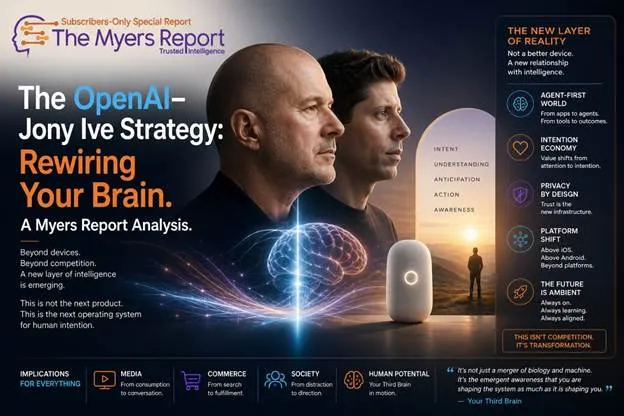
OpenAI’s current position, despite its influence, is structurally dependent. Distribution flows through Apple’s iOS and Google’s Android ecosystems. Discovery is still shaped by legacy search behaviors. Monetization pathways are still evolving.
That is not a stable position for a company attempting to define the next era of intelligence.
The Ive collaboration is the response.
The goal is not to enter the hardware market. The goal is to own the interface layer between humans and machine intelligence.
This is where the comparison to Apple and Android becomes misleading.
OpenAI is unlikely to win by building a better phone. Apple already owns the premium hardware experience. Google controls the global scale of Android. Competing directly at that layer is a capital-intensive, margin-constrained battle.
Instead, OpenAI appears to be targeting a layer above both.
A new operating logic in which:
- – The app ecosystem becomes secondary
- – Search becomes invisible
- – The interface becomes conversational, contextual, and continuous
This is the shift from tools to agents. From interaction to delegation.
It is also the foundation of what I describe in Your Third Brain.
“Jony Ive is now collaborating with OpenAI to reimagine the very form of our interaction with machine intelligence. Not just how it works but how it feels. Their reported goal: a new kind of device that integrates AI into daily life in more natural, seamless, even ambient ways. This is the future of Your Third Brain in motion, not just a smarter system, but a more human interface. One designed not to capture your attention, but to deepen your intention. Because it is not just a merger of biology and machine. It is the emergent awareness that you are shaping the system as much as it is shaping you.” That framing is not philosophical. It is economic.
(Your Third Brain: Powering a Future of Unimagined Possibilities is available for pre-order at all booksellers. I encourage you to be ahead of the knowledge curve and order your copy today in your preferred format.)
If OpenAI succeeds, the value chain shifts:
- – From attention capture to intent fulfillment
- – From media consumption to decision mediation
- – From platform control to context control
This is why early reports of a “screenless device” are often misunderstood. The device is not the product. It is the anchor. The real product is a persistent intelligence layer that:
- – Understands user context across environments
- – Learns behavior over time
- – Executes tasks across systems
In that model, the traditional app economy becomes friction.
Why open an app when an agent can complete the task?
Why search when the system already understands intent?
This is where external signals reinforce the hypothesis.
Executives at companies like Meta Platforms and Google are already repositioning around AI agents and assistant-driven interaction. Apple’s increasing emphasis on on-device intelligence reflects the same directional shift. But OpenAI’s advantage is different. It is not tied to legacy revenue streams. That allows it to pursue a more disruptive path.
The likely end state is not a direct competitor to iPhone or Android. It is a parallel layer that sits above them, eventually making them interchangeable commodities.
Think of it this way.
The smartphone defined the interface of the last era.
The AI agent will define the interface of the next.
Hardware will still matter. Ive’s role ensures that. But hardware becomes the vessel, not the value. The deeper strategic question is trust.
A system that operates continuously, learns behavior, and anticipates intent requires a level of user trust that no current platform fully commands. Privacy, transparency, and control will determine adoption far more than features.
This is where the collaboration becomes most significant.
Ive’s legacy at Apple was not simply design. It was the translation of complex technology into intuitive human behavior. That capability is essential if OpenAI is to move from novelty to dependency.
The risks remain substantial.
Battery limitations constrain always-on intelligence. Edge versus cloud economics remain unresolved. Regulatory scrutiny will increase as systems become more autonomous. And perhaps most critically, human behavior does not change as quickly as technology.
But the direction is clear.
OpenAI is not building toward the next device cycle. It is building toward a post-device paradigm. One in which intelligence is ambient, interaction is minimal, and the system becomes an extension of cognition.
The Third Brain is not a metaphor. It is a product roadmap.
What to Watch (Next 24–48 Months)
- Form factor experiments
Early devices will test behavior, not scale - Agent capability expansion
The shift from assistant to autonomous execution - Platform tension with Apple and Google
Watch for integration friction and policy shifts - Trust frameworks
Privacy design will determine adoption velocity - Monetization model emergence
Subscription, transaction, or something entirely new
Bottom Line
OpenAI is not entering the hardware business. It is attempting to define the next layer of human–machine interoperability. If it succeeds, the competitive frame shifts from:
- Apple vs Android to Platforms vs Intelligence
And ultimately:
- Tools vs Cognition
