
What ties the strongest April editions of The Myers Report together is not simply artificial intelligence, media disruption, or leadership under pressure. It is something more fundamental: the accelerating collapse of inherited assumptions.
Across platforms, agencies, legacy media, enterprise leadership, and the economics of advertising itself, the same pattern emerges. Systems built for a slower era are being stress-tested by technologies, market forces, and behavioral shifts moving at a pace few leaders are structurally prepared to manage.
This is the common thread behind these commentaries. Not AI as novelty. AI as pressure. Not disruption as a buzzword. Disruption as economic reallocation, cultural restructuring, and strategic consequence.
Some of these essays challenge conventional wisdom. Others offer frameworks for navigating uncertainty. Together, they reflect what The Myers Report has become: a field guide for leaders making decisions inside transformation, not merely observing it.
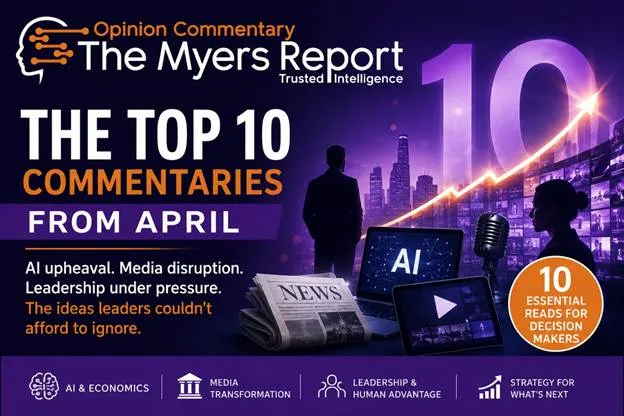
From AI’s economic shockwaves to the revaluation of legacy media, collapsing business models, and the rising premium on human judgment, these are the April commentaries that captured the anxieties, opportunities, and strategic decisions reshaping business leadership. This post is public so feel free to share it. Scroll down for the full Top 10 list.
1. K.G.M. v. META et al: Collapse of the Engagement-at-All-Costs Model
A highly strategic legal-economic analysis that hits your audience’s intersection of platform accountability, media economics, and structural market change.
2. AI Just Hit Two Tipping Points. Most Marketing Leaders Are Not Prepared
(1) AI Just Hit Two Tipping Points. Most Marketing Leaders Are Not Prepared.
Classic Myers Report positioning: urgency, asymmetrical insight, executive anxiety, and decision relevance around AI adoption.
3. Collapse of the Legacy Holding Company Model
(1) Collapse of the Legacy Holding Company Model
One of your strongest recurring themes, directly relevant to agencies, investors, and brand-side transformation leaders.
4. The Re-Emergence of Legacy Media
(1) Redux: The Re-Emergence of Legacy Media – by Jack Myers
This aligns directly with your Rai, broadcaster, and premium environment thesis, making it exceptionally resonant for senior operators.
5. The Rehumanizing Premium: Why Empathy Is Becoming the Last True Competitive Advantage
(1) The Rehumanizing Premium: Why Empathy Is Becoming the Last True Competitive Advantage
One of your most differentiated intellectual properties because it bridges human leadership with economic outcomes rather than abstract philosophy.
6. Empathy as Infrastructure: Part 2 – Building the Rehumanizing Premium
(1) Empathy as Infrastructure: Part 2 – Building the Rehumanizing Premium
Follow-up pieces often underperform, but this one likely sustained strong readership because it operationalizes the thesis for decision-makers.
7. Danger-time at Nexstar/TEGNA, Paramount-Skydance-WBD, and Live Nation
(1) REDUX: Danger-time at Nexstar/TEGNA, Paramount-Skydance-WBD, and Live Nation
High-value because it combines market intelligence, named entities, structural forecasting, and executive intrigue. Nexstar Media Group Paramount Warner Bros. Discovery Live Nation
8. Why Integration Beats Innovation. Part II
(1) Why Integration Beats Innovation. Part II – by Jack Myers
A very Myers Report argument because it runs counter to Silicon Valley orthodoxy and gives operators a practical leadership lens.
9. $250B in Ad Budget AI Reallocation: Bad News for Media
(1) $250b in Ad Budget AI Reallocation: Bad News for Media.
This likely drove strong engagement because it is highly quantitative, provocative, and directly tied to revenue consequences. AI ad budget reallocation thesis
10. Stop Performing. You’re Destroying Enterprise Value.
(1) Stop Performing. You’re Destroying Enterprise Value.
For readers new to The Myers Report, these ten commentaries offer a clear window into the questions shaping the future of media, marketing, technology, and leadership. They are written not to chase headlines, but to interpret what the headlines mean before the implications become obvious.
If your work involves navigating AI, organizational reinvention, media economics, consumer trust, or the human consequences of technological acceleration, these pieces are intended to challenge assumptions and sharpen decision-making.
Explore them. Debate them. Share them.
And if the questions they raise feel to the decisions ahead, I invite you to become a regular reader of Threlevant e Myers Report, where the focus is not on predicting the future, but helping leaders think clearly enough to shape it.
