You are not competing for attention anymore. You are competing for trust, judgment, and meaning in a world where intelligence is everywhere.
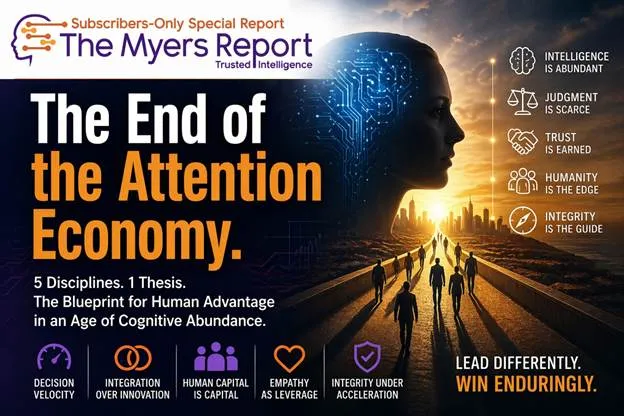 Across the five-part interconnected analysis “What Happens When Intelligence is Free” published by The Myers Report (see links below), a single reality emerges: as intelligence becomes abundant, leadership advantage shifts from technology to integration, talent, empathy, and integrity. Judgment, Trust, and Humanity are the new scarce assets. The companies that understand this shift will not just compete. They will define the next era of economic value.
The End of the Attention Economy. The Beginning of the Human Advantage Economy.
For more than a decade, business strategy has been organized around a single premise: attention is scarce, and those who capture it win. That premise is no longer sufficient. Following in this article is a summary of The Myers Report 5-part series “What Happens When Attention is Free.” Read the full series in the archive at themyersreport.substack.com. What follows is not only a recap of five articles. It is also a unified framework for leaders navigating the next decade.
We have trained our tools to think like us. And now, they are doing something more disruptive; they are thinking for us. This is not about some future dystopia. It’s about the frictionless convenience of now. And the more seamlessly these systems operate, the less aware we are of their influence. Influence and attention after all, do not require consent. only exposure.
Across the five-part “What Happens When Attention is Free” Third Brain series from The Myers Report, a new ecosystem emerged. One that is less visible, more structural, and far more consequential. Intelligence is becoming abundant. And when any resource becomes abundant, value shifts.
The attention economy did not disappear. It was absorbed into something larger. A new operating system for leadership is taking shape. It is defined by five disciplines. Together, they form a single thesis:
In an age of cognitive abundance, competitive advantage migrates from access to intelligence toward:
- quality of human judgment
- integration of systems
- leverage of talent
- depth of empathy
- integrity of leadership.
This is the foundation of what I describe as Your Third Brain, the subject of my upcoming book due in August and available for pre-order now.
The Five Disciplines of the New Economy
1. Decision Velocity
Article I: AI Is Making Intelligence Cheap. What Happens Next?
The series begins with a simple but underappreciated shift. When intelligence becomes abundant, it stops being the differentiator.
AI systems are already writing code, generating strategy, and compressing decision cycles. The economic implication is direct. As supply increases, scarcity disappears.
The scarce asset becomes judgment. The organizations that win will not be those with the most advanced tools. They will be those that make better decisions faster, without sacrificing coherence.
This is decision velocity. Not speed alone. Speed with discernment.
Most companies are increasing intelligence capacity while leaving decision architecture unchanged. The result is friction. The leaders who remove that friction gain structural advantage.
2. Integration Over Innovation
Article II: Why Integration Beats Innovation
The second discipline exposes the hidden constraint inside most organizations.
Not lack of AI. Not lack of data. Lack of integration. Companies are layering intelligence onto fragmented systems. Data silos, functional silos, and misaligned incentives create a quiet but expensive drag on performance.
AI accelerates output. Fragmentation slows outcomes.
The economic cost is measurable. Duplicate work. Delayed decisions. misallocated capital. The real advantage belongs to organizations that operate with what I call the Discipline of Harmony.
Integration is not alignment as aspiration. It is coherence as operating system. In a world where intelligence is abundant, coordination becomes power.
3. Human Capital as Capital Allocation
Article III: The Nexus Generation Is Not Waiting
If integration reshapes organizations, talent reshapes the system itself. A new workforce is already operating inside your business, whether you recognize it or not. GenNexus is not defined by age. It is defined by relationship to intelligence.
This is the first generation to grow up with AI as collaborator, not tool.
They do not learn AI. They think with it.
The strategic implication is immediate. Talent strategy is no longer an HR function. It is a capital allocation decision. Organizations still budget for labor.
GenNexus operates as a multiplier. They build, create, and collaborate across systems instinctively. They expect fluidity, speed, and autonomy. And they are already outperforming legacy structures in small, AI-native teams.
The risk is not a talent shortage. The risk is failing to recognize value.
4. The Rehumanizing Premium
Article IV: Empathy as Economic Leverage
As intelligence and capability spread, differentiation shifts again.
When everyone can optimize, optimization stops differentiating. What remains scarce is human understanding. Empathy is no longer a cultural aspiration. It is economic infrastructure.
Automation scales efficiency. Empathy scales allegiance.
The companies that win will be those that understand not just what customers do, but why they care. Not just how employees perform, but how they experience change.
This creates what I call the Rehumanizing Premium.
Empathy increases lifetime value, strengthens trust, improves retention, and compounds margin. In an AI-saturated market, human understanding becomes the signal that guides strategy.
5. Integrity Under Acceleration
Article V: The Hidden Cost of Quarterly Myopia
The final discipline determines whether any of the others survive.
Acceleration creates pressure. Markets reward short-term performance. Technology enables rapid change.
The question is not whether organizations can move faster. It is whether they can move fast without abandoning long-term judgment. Integrity is not moral language in this context. It is strategic discipline.
Without it, intelligence accelerates mistakes. With it, intelligence compounds value.
History is consistent on this point. The companies that endure technological revolutions are not those that move fastest in every moment. They are those that build systems that last.
Integrity connects purpose, incentives, and decision-making. It is the operating system that sustains everything else.
The Cohesive Thesis
Taken together, these five disciplines form a single, unavoidable conclusion.
The attention economy trained leaders to optimize for visibility. The next economy requires leaders to optimize for coherence.
Coherence across decisions. Across systems. Across talent. Across human experience. Across time horizons.
The shift is structural.
• From intelligence scarcity to intelligence abundance
• From information advantage to judgment advantage
• From innovation theater to integrated systems
• From labor models to cognitive leverage
• From efficiency to empathy
• From speed alone to integrity under pressure
This is not a technology story. It is a leadership story.
What Leaders Must Understand Now
Most organizations are still solving for the previous era.
They are investing in tools, optimizing metrics, and pursuing visibility.
Meanwhile, the system has already changed.
A generation is operating differently.
Markets are rewarding different behaviors.
Value is migrating.
The leaders who recognize this early will not just adapt. They will set the terms of competition.
Those who do not will experience something more subtle than disruption.
They will experience erosion.
Slower decisions. Misaligned teams. Underutilized talent. Commoditized offerings. Declining trust.
All while believing they are keeping pace.
The Myers Report Position
For more than four decades, The Myers Report has focused on one central intersection.
Where business, culture, technology, and human behavior meet.
This series reflects that lens. Not trend analysis. Not technology reporting. But signal identification.
The shift from attention to human advantage is not theoretical. It is already shaping capital allocation, talent strategy, and competitive positioning across industries.
For leaders responsible for navigating that shift, the question is not what AI can do.
The question is how your organization thinks, integrates, leads, and decides in response.
That is the work. And increasingly, it is the work leaders are bringing into their boardrooms, their conferences, and their organizations.
Final Reflection
Intelligence is no longer rare.
Humanity still is.
The organizations that understand the difference will define the next decade.
Reader Question
What is the one leadership decision you are making today that reflects long-term judgment rather than short-term pressure?
