
Survey of 18-24 year-olds asks the question “Is anything online real.” AI is not a technology story. It’s a trust story, says a University of Missouri study.
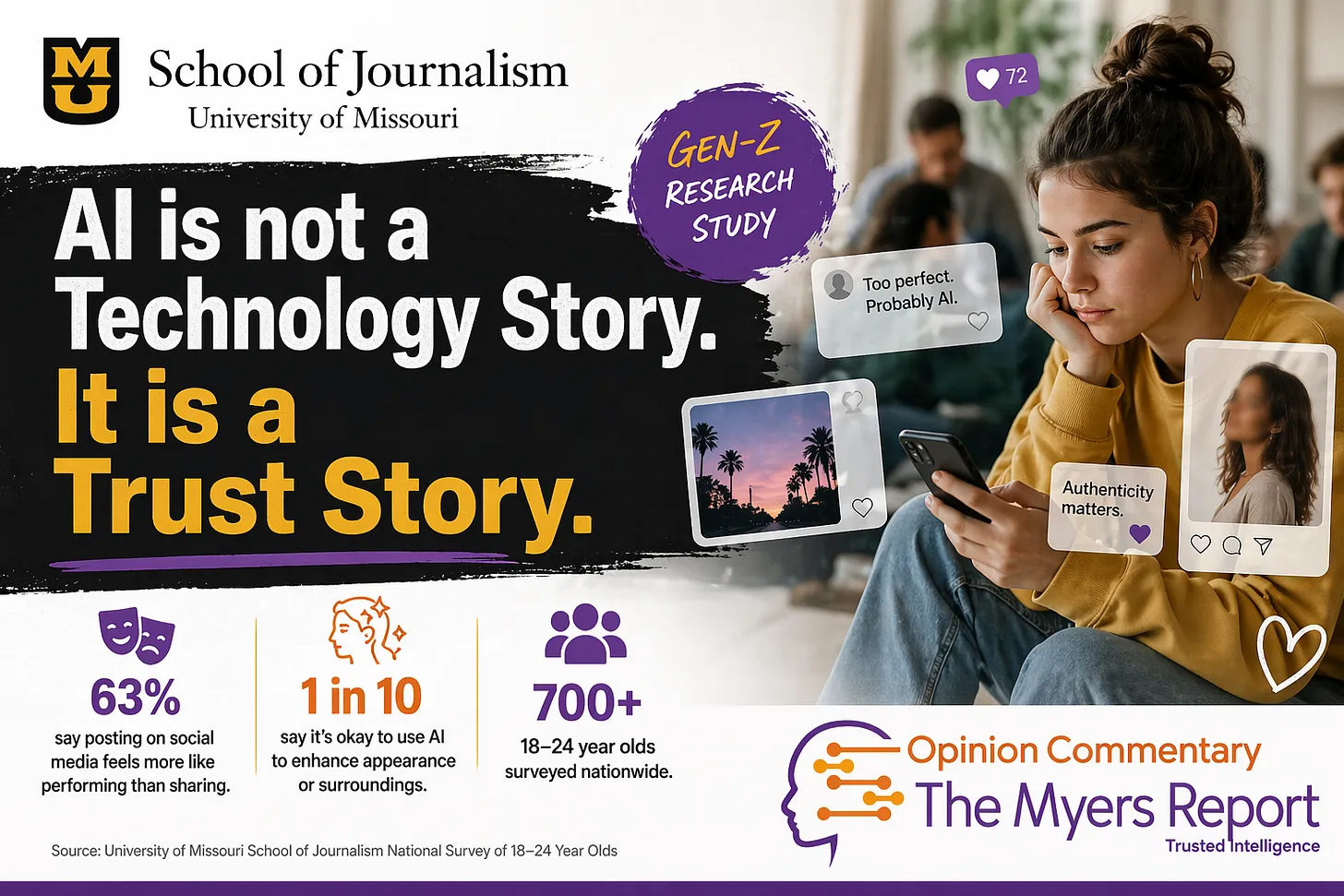
The most important signal in AI right now is not adoption. It is resistance. A new national study from the University of Missouri School of Journalism surveying more than 700 young adults ages 18 to 24 surfaces a tension that most leaders are underestimating. The issue is not whether AI is being used. It is whether anything online still feels real.
That distinction matters more than any capability curve. Young adults are not rejecting AI. They are rejecting what AI reveals about us. The next battle for growth will not be about capability. It will be about credibility, trust, and human connections.
63% of respondents say posting on social media feels more like performing than sharing. Only one in ten believe it is acceptable to use AI to enhance appearance or surroundings when trying to present something authentic.
This is not a technology story. It is a trust story. And trust, increasingly, is an economic variable.
The data reveals a paradox that should concern every brand, platform, and executive investing aggressively in AI-driven content systems. Young consumers are open to AI in certain contexts. 79% are comfortable with AI-generated images. More than half accept AI-generated video. But when AI crosses into identity, into self-presentation, into the projection of who someone is, acceptance collapses.
In other words, AI is tolerated as a tool. It is rejected as a mask. That line is not philosophical. It is behavioral. And it is tightening.
The deeper signal sits beneath the quantitative data. In interviews, respondents consistently describe authenticity not as a preference, but as a psychological requirement. “If you’re not being authentic to yourself, you lose sight of who you are.” “You can’t keep up a fake version forever.” “It would affect my mental health.”
This is not aesthetic discomfort. It is identity erosion.
Ashley Rodio, Account Manager at the University of Missouri School of Journalism, captures the contradiction precisely for The Myers Report: “The bottom line is 18- to 24-year-olds do not want to surround themselves with fakeness, whether that be from brands, influencers, or their peers, but they understand that they must in order to keep community. The same goes for AI usage. This age group does not want to surround themselves with the artificiality of AI, but recognize that they must, to keep from falling behind in a technology driven world.”
That is the market condition. Participation without belief. Engagement without trust. Adoption without endorsement. For business leaders, the implications are immediate and structural.
First, the long-assumed equation between polish and performance is breaking down. The more “perfect” content becomes, the more it signals artificiality. In a system where AI can optimize everything, imperfection becomes the only credible signal of humanity.
Second, differentiation is at risk of collapse. If AI standardizes expression, tone, and aesthetics, then authenticity becomes the only remaining variable. One respondent put it bluntly: if everyone presents the same version of themselves, “there won’t be new ideas or inventions.” That is not a social critique. It is an innovation warning.
Third, the cost of inauthenticity is compounding. 75% of respondents say fear of judgment already makes people less authentic. AI does not relieve that pressure. It amplifies it. Which means the systems being built to scale content may be simultaneously degrading the conditions required for creativity, trust, and long-term engagement.
This is where most current AI strategies are miscalibrated. They are optimizing for output, not for belief. They are scaling content, not credibility. They are accelerating production in an environment where the audience is increasingly skeptical of anything that feels engineered.
The result is a widening gap between what companies can produce and what audiences will trust.
That gap is where enterprise value will be won or lost.
The leaders who recognize this early will not abandon AI. They will reframe its role. AI will be used to enhance insight, to improve relevance, to reduce friction. But it will be constrained at the point of identity. At the point of voice. At the point where trust is either built or broken.
Because the emerging reality is clear. In a world where anything can be generated, the only thing that cannot be manufactured at scale is belief. And belief is the new scarcity.
The question is not whether your organization is using AI. It is whether your audience believes what they are seeing. What happens to your brand, your leadership, and your economics if they stop believing?
READER QUESTION: Does content that is obviously AI written feel more or less trusted?
This post is public so feel free to share it.
The Myers Report is exclusively a reader-supported publication. To support my work and research, and to send a positive signal, please become a free or paid subscriber for special content.
