
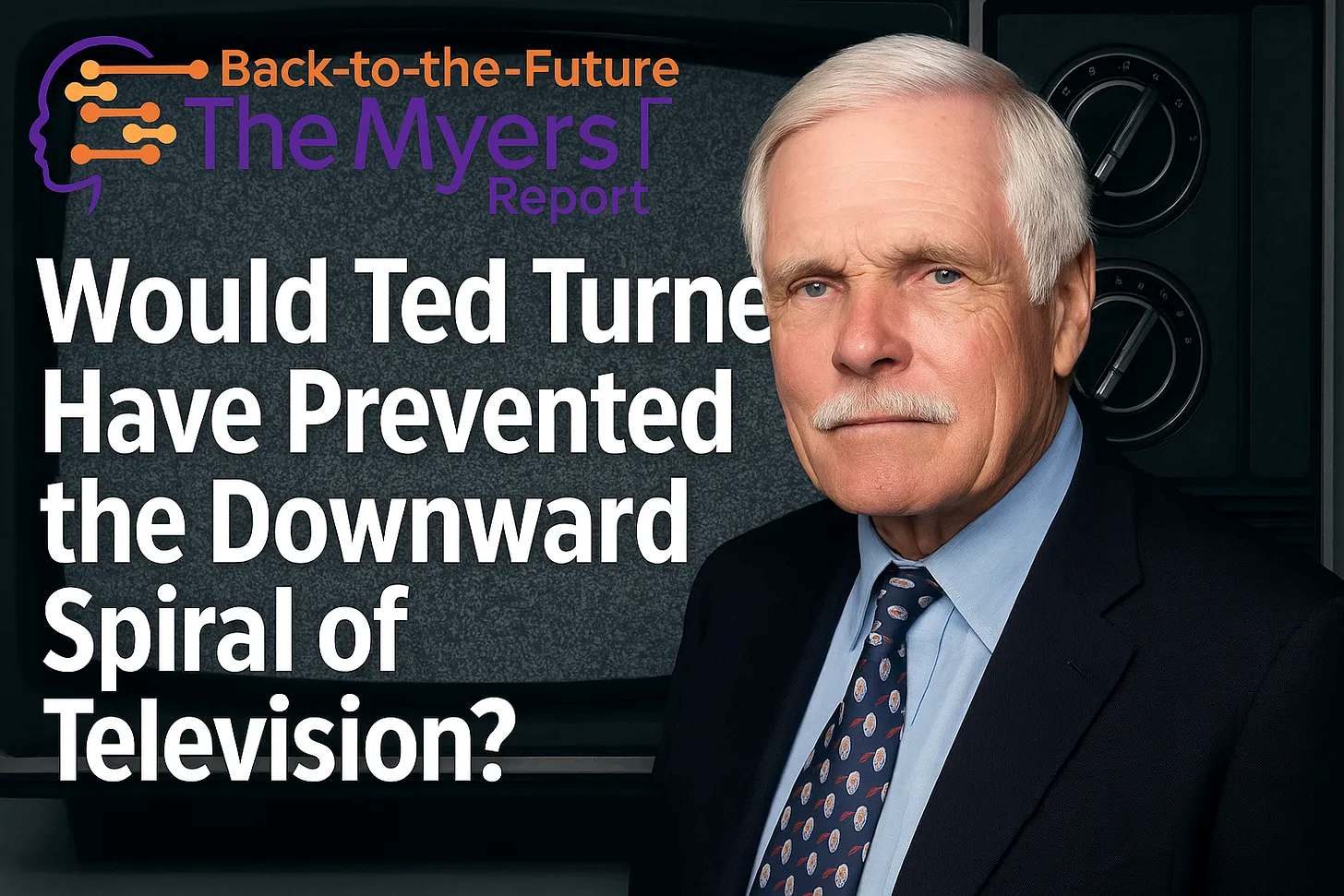
 Television once defined culture. Today it chases it. The medium that once shaped trust must now earn it back or risk becoming a footnote in the history of mass media. PLUS: The Ultimate Irony!
The Fork in the Road: Turner vs. CBS
In 1985, Ted Turner attempted what many saw as unthinkable: a takeover of CBS. His audacious bid, ultimately rejected by CBS leadership, became more than a failed corporate raid—it was a symbol. It represented the moment the television industry chose entrenchment over reinvention. Turner was an activist and visionary, the founder of CNN, and a relentless disrupter who imagined television as both a cultural force and a global service. CBS, by contrast, clung to legacy prestige, unwilling to risk radical change.
That fork in the road is where the downward spiral of television’s economic value, equity reputation, and advertiser commitment truly began. What followed over the next four decades was not a story of bold invention but of consolidation, financial engineering, and defensive postures that eroded the medium’s once unassailable status.
The Golden Age of Dominance
In the 1970s and early 1980s, television was the unrivaled cultural engine. The three broadcast networks—ABC, CBS, and NBC—commanded national attention, defined cultural narratives, and built advertising’s most durable brands. For advertisers, television was the mass-trusted medium, a platform where brands didn’t just sell products; they cemented identity and prestige.
But Turner saw cracks forming. Cable distribution, niche channels, and emerging technologies were signals that the one-size-fits-all broadcast model was fragile. Where the networks saw threats, Turner saw opportunity: “Do something. Either lead, follow, or get out of the way,” he was fond of saying. CBS chose none of the above.
Paramount, Viacom, and the MTV Engine
Meanwhile, another axis of disruption was brewing in the form of Viacom and its jewel, MTV Networks. With MTV, Nickelodeon, and VH1, Viacom delivered what the networks could not: youth attention, sticky communities, and cultural risk-taking. Advertisers noticed.
Bob Pittman, who is credited with co-founding MTV, famously quipped, “At MTV, we don’t shoot for the 14-year-olds, we own them.” That was not just marketing bravado—it was the articulation of a new media truth. Attention could be segmented, monetized, and sold with cultural cool attached.
By 1994, Viacom acquired Paramount Communications for more than $10 billion, cementing Sumner Redstone’s declaration that “content is king.” Just a few years later, in 1999, Viacom acquired CBS in a $36 billion deal. The child had swallowed the parent.
Yet, while this was hailed as empire-building, it also tethered MTV’s edgy youth brands to an aging broadcast model. The energy that could have powered reinvention was instead absorbed into the gravitational pull of CBS’s legacy culture.
Turner’s Path: CNN, Time Warner, and the AOL Disaster
Turner didn’t get CBS, but he built his empire nonetheless. CNN, TNT, and TBS reshaped the cable landscape, and in 1996, Time Warner acquired Turner Broadcasting for $7.5 billion.
Just four years later came the corporate disaster that would forever mark the industry’s hubris: the AOL–Time Warner merger, with which MTV’s Pittman, who now heads SiriusXM, was also involved. Valued at $182 billion, it was billed as the “marriage of old and new media,” the future of convergence. Instead, it became one of the largest write-downs in corporate history—$99 billion in 2002. What was promised as synergy became dysfunction. What was supposed to rebuild television’s future instead hollowed out its credibility.
Telco Bets and Lifestyle Scale
By the mid-2010s, the next defensive strategy emerged: telco vertical integration. AT&T’s $85 billion acquisition of Time Warner in 2018 was pitched as the perfect marriage of pipes and programming. Distribution would meet content, unlocking efficiencies and growth. Instead, regulatory battles and corporate inertia slowed momentum, just as Netflix and Amazon Prime accelerated the streaming wars.
Discovery, meanwhile, pursued a different path: scale in lifestyle and unscripted. Its $14.6 billion acquisition of Scripps Networks Interactive (HGTV, Food Network, Travel Channel) in 2018 created an advertising behemoth. For a time, it worked. Costs were cut, audiences were stable, and advertisers leaned in. But the strategy was rooted in linear television at the exact moment viewers were abandoning schedules for on-demand.
Warner Bros. Discovery: Brand Aura Meets Balance Sheet
The ultimate consolidation came in 2022, when AT&T spun off WarnerMedia and merged it with Discovery to create Warner Bros. Discovery (WBD). On paper, the portfolio was staggering: HBO, CNN, Warner Bros. film, Discovery lifestyle. In practice, it came with more than $40 billion in debt and a bruising series of cost cuts, library write-downs, and cultural missteps.
David Zaslav, the CEO of WBD, declared in 2023, “Our U.S. streaming business is no longer a bleeder,” signaling a pivot from subscriber growth to profitability. By 2025, Zaslav was re-rebranding the company’s flagship streamer, restoring the HBO name he had stripped a year earlier: “We are bringing back HBO, the brand that represents the highest quality in media.” It has now rebranded once again to HBO MAX.
For advertisers, this was whiplash. Stability and trust are the currency of brand safety. WBD’s debt load and constant pivots made commitments harder to justify.
Paramount–Skydance and the Looming WBD Play
SCROLL DOWN TO CONTINUE READING THIS FULL COMMENTARY. YOU’LL FIND A HANDY SUBSCRIPTION BUTTON BELOW THAT I HOPE YOU’LL CONSIDER USING IF YOU APPRECIATE THIS STORY.
As WBD struggled, another consolidation wave gathered. Paramount Global, merged with David Ellison’s Skydance in 2025, now looms as a potential acquirer of WBD. Analysts speculate on whether combining Paramount–Skydance’s film franchises and Paramount+ with WBD’s portfolio could finally create a competitor to Big Tech.
The upside: a unified premium video platform with global reach, potentially simplifying advertiser buying and restoring some of television’s lost clout.
The downside: yet another merger laden with debt, cultural clashes, and short-term cost cuts at the expense of long-term trust. Advertisers have seen this movie before, and they are increasingly unwilling to finance it.
The Free Press Gambit: Bari Weiss and Legacy News
One of the more provocative elements in this unfolding drama is this week’s acquisition by Paramount–Skydance of The Free Press, Bari Weiss’s startup news platform. Valued at $150 million, the deal positions Weiss to lead CBS News, and perhaps even coming full circle back to Turner’s CNN if a WBD acquisition materializes. Such bittersweet ironies seem to permeate the history of television.
The Free Press describes itself as “built on honesty, doggedness, and fierce independence.” To supporters, this represents the kind of editorial reset legacy news desperately needs. To critics, it risks dragging CBS more deeply into culture-war politics, alienating broad swaths of audiences and advertisers.
What’s undeniable is that news—once television’s crown jewel of trust and prestige—has become a liability. The Weiss gambit is either a bold rebranding play or the final fracture of TV news as we’ve known it.
Advertisers: From Commitment to Caution
Through all of this, advertisers have steadily withdrawn their commitment to linear television. The upfronts, once ritualistic, are no longer inevitable. Budgets follow engagement and trust, which increasingly reside on platforms like YouTube, TikTok, and connected ecosystems powered by data and measurement.
Television once sold cultural certainty. Today it sells uncertainty: shifting brands, fragmented audiences, unstable leadership, and measurement disputes.
Sumner Redstone’s maxim that “content is king” feels antiquated in an era when distribution, data, and outcomes drive decisions.
The Counterfactual: If Turner Had Won
What if Turner had succeeded in acquiring CBS in 1985? Imagine a CNN-CBS news spine that combined broadcast reach with global cable newsgathering, decades before Fox News or MSNBC reshaped the landscape. Imagine CBS sports and entertainment infused with Turner’s activist ethos, experimenting with 24/7 formats, global partnerships, and brand reinvention.
Instead of four decades of mergers designed to defend legacy models, the industry might have embraced product innovation as its cultural currency. Instead of AOL–Time Warner, we might have seen a bold pivot into digital distribution and news credibility that could have extended television’s trust into the internet age.
Turner’s ethos was never about defending the past; it was about provoking the future. His failure to secure CBS locked the industry into a cycle of defensive consolidation.
Lessons for Leaders and Advertisers
The lessons are clear.
For industry leaders: stop chasing merger headlines. Debt and scale will not rebuild trust. Invest in transparent measurement, interoperable identity, and product experimentation that puts audiences first.
For advertisers: do not be seduced by legacy prestige. Demand proof of value creation and equity protection. Insist on co-developing formats that turn attention into commerce, fandom into outcomes, and storytelling into cultural capital.
Television’s future will not be saved by another balance-sheet maneuver. It will be saved only by humility, creativity, and a willingness to lead.
Closing Reflection
The decline of television is not the story of technology. It is the story of leadership choices—choices to defend incumbency rather than risk reinvention. From the CBS rejection of Turner in 1985 to the AOL–Time Warner debacle, from Viacom’s absorption of CBS to the debt-laden WBD merger, the pattern is clear.
Television once defined culture. Today it chases it.
If there is to be a recovery, it will not be written in the language of mergers or debt covenants. It will be written in the language Turner understood: boldness, experimentation, and cultural conviction.
The medium that once shaped trust must now earn it back—or risk becoming a footnote in the history of mass media.
The Myers Report provides our Substack subscribers with regular research and future-focused forecasts and trend analyses in addition to our free thought leadership, back-to-the-future commentaries, book excerpts, and creativity unleashed AI tips, tools, and problem-solving. By becoming a paid subscriber at only $95 annually, you’re guaranteed full value plus access to me personally for speaking opportunities and market guidance. Use the quick subscription link below to let me know you value my work and my more than 40-years of dedicated commitment to the media and advertising business.
